
A Facility-Specific Guide from a Company That’s Done It for 24 Years
Your VCT floors are telling you something. That yellowing in the hallway. The scuff marks that won’t buff out anymore. The dull, grayish film in high-traffic areas that makes your entire facility look ten years older than it is.
Those aren’t cosmetic problems. They’re warning signs that your floor’s protective wax layer has broken down — and every day you wait, you’re accelerating damage to the tile underneath.
At Citi Cleaning Services, we’ve been stripping and waxing VCT floors across Florida for over two decades. Warehouses. Retail chains. Office buildings. Logistics terminals. We’ve seen what happens when floor care stays on schedule — and we’ve seen the repair bills when it doesn’t.
This guide gives you a real-world stripping and waxing schedule based on your facility type, your foot traffic, and the specific conditions that affect VCT floors in Florida’s climate. No textbook answers. Just what actually works.
⚡ KEY TAKEAWAYS
VCT (Vinyl Composition Tile) is one of the most common commercial flooring materials in the country. You’ll find it in retail stores, warehouse offices, distribution centers, lobbies, and break rooms. It’s durable and cost-effective — but it’s not self-maintaining.
Stripping is the process of chemically removing every layer of old wax, embedded dirt, and buildup from the tile surface. It takes the floor back to bare tile.
Waxing (also called “finishing”) is applying multiple thin coats of commercial floor finish to create a protective, high-gloss barrier. This barrier shields the tile from moisture, scuffs, stains, and foot traffic wear.
Think of it like this: wax is to VCT what sealant is to concrete or clear coat is to a car’s paint. Without it, you’re exposing the raw material to everything your facility throws at it. And in Florida — where humidity, rain tracking, and sand are constant factors — that exposure accelerates fast.
The generic answer you’ll find everywhere online is “every 6 to 12 months.” That’s technically not wrong. But it’s not helpful either, because it doesn’t account for what your facility actually looks like on the ground.
After 24 years of servicing VCT floors across hundreds of Florida facilities, here’s what we’ve found actually holds up:

Recommended: Every 3–4 months (quarterly)
Retail floors take the heaviest foot traffic of any commercial environment. Hundreds or thousands of people walk through daily, many of them tracking in moisture, dirt, and debris from parking lots. The wax layer breaks down fast. If you’re a maintenance management company coordinating floor care for multi-location retail brands, quarterly strip and wax is the standard that keeps floors consistent across every store.
Recommended: Every 4–6 months
Warehouse VCT is primarily found in office areas, break rooms, and front lobbies — not the dock floor itself. These areas see steady traffic from employees, drivers, and visitors. The twist in logistics facilities is that the traffic brings in heavier contaminants: dock grit, oil residue, forklift tire marks. That’s harder on wax than regular foot traffic. We service several logistics and transportation facilities in the I-4 corridor, and the 4–6 month cycle consistently maintains floor integrity.
Recommended: Every 6–9 months
Multi-tenant office buildings have more predictable traffic patterns. Lobbies and hallways need attention more frequently than individual suite corridors. If the property management company has a daily porter buffing floors between strip cycles, you can often stretch to 9 months or even annually in lower-traffic areas. The key is having that interim maintenance in place — without it, 6 months is the maximum before you start seeing noticeable degradation.
Recommended: Quarterly or semi-annual, standardized across all locations
If you’re a maintenance management company coordinating floor care for a retail brand with 10, 15, or 20 Florida locations, standardization is everything. Your client expects every store to look the same. That means one vendor, one process, one quality standard, and a fixed schedule across every location. We cover all of Florida for strip-and-wax projects, which eliminates the inconsistency of using different local vendors in different markets.
The schedule above is a starting point. Here are the real-world variables that push the timeline shorter or longer:
This is the single biggest factor. A retail store seeing 2,000 visitors a day will burn through wax three times faster than an office suite with 40 employees. Volume wears wax. There’s no shortcut around it.
Humidity matters more than most people realize. Florida’s moisture levels cause wax to soften and break down faster than in drier states. Rain tracking is another issue — water carried in on shoes creates mineral deposits that dull the floor surface. If you’ve ever noticed your floors look worse during rainy season even though nobody’s scuffing them, that’s humidity at work.
Facilities that invest in daily dust mopping, weekly auto-scrubbing, and regular high-speed buffing can extend strip intervals significantly. Floors that only get a mop and bucket will need stripping two to three times more often. Daily maintenance isn’t a substitute for stripping and waxing — but it dramatically extends the life of each wax application.
Not all floor finishes are equal. A high-solids finish (20–30% solids content) lasts longer and builds up a harder protective layer than a bargain-grade product. Equally important is the number of coats applied. In our experience, four to five thin coats produce the best results. Some vendors cut corners with two to three coats to save time. That shortcut shows within weeks.
An office tracking in shoe dust is different from a warehouse tracking in dock grit and oil. Facilities near construction sites, sandy areas, or unpaved lots will see faster wax degradation. Florida’s sandy soil is a constant factor — even urban facilities deal with fine sand carried in from parking lots.
Don’t wait for the calendar to tell you. Watch the floor. It’ll tell you first.
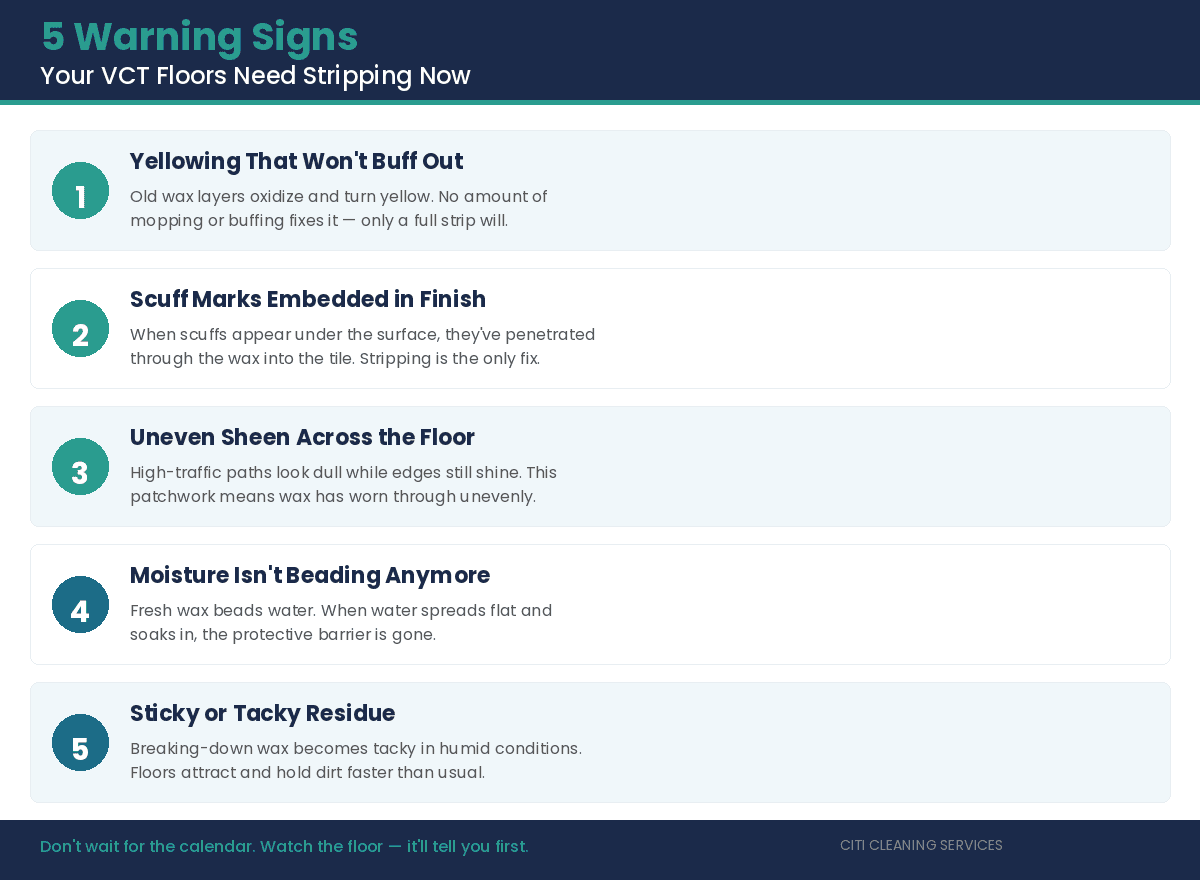
Here’s the part nobody wants to hear, but every facility manager needs to understand: skipping strip and wax doesn’t save money. It accelerates cost.
When the wax layer wears through, the bare VCT tile is directly exposed to foot traffic, moisture, chemicals from cleaning products, and abrasive dirt. VCT is a porous composite material. Without that protective barrier:
Cleaning is an investment in your facility, not an expense to minimize. That’s the principle we operate on at Citi Cleaning, and it applies directly to floor care. The cost of a scheduled strip and wax is a fraction of the cost of premature tile replacement.
Getting on a good schedule is only half the equation. The other half is making sure the company doing the work actually knows VCT.
VCT floor care is a specialty. It’s not general janitorial work with a bigger mop. The stripping chemicals, the number of wax coats, the drying time between coats, the neutral rinse after stripping, the type of floor finish — all of these variables affect the result and the longevity of the work.
Here’s what goes wrong when a generalist cleaning company handles VCT strip and wax:
At Citi Cleaning, VCT strip and wax is one of our core service lines — not a side offering. Our crews are trained specifically in VCT floor care, and we use commercial-grade, high-solids floor finishes that are selected for Florida’s climate conditions.
If you’ve never had VCT floors professionally stripped and waxed before — or if your previous vendor didn’t explain the process — here’s what a thorough job looks like:

The full process typically takes one night for a standard commercial space, done after business hours so there’s zero disruption to operations. Larger retail locations or warehouses may require two nights depending on floor area.
Most of the strip-and-wax guides you’ll find online are written by companies in the Northeast or Midwest. Florida is a different operating environment.
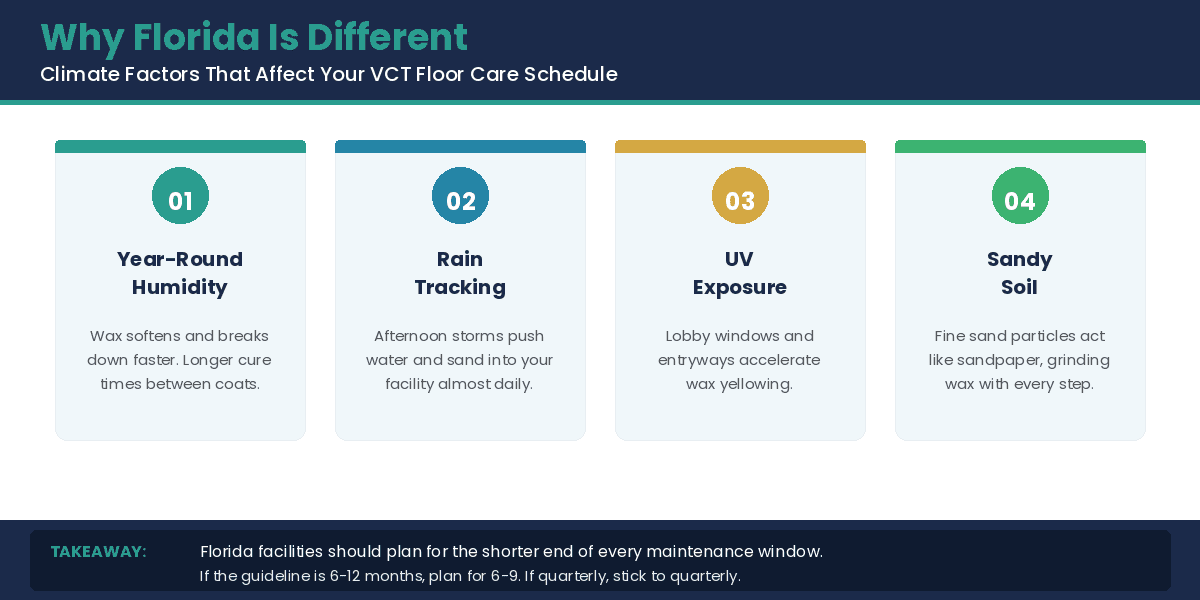
All of these factors mean Florida facilities generally need to be on the shorter end of every recommended maintenance window. If the general guideline is 6–12 months, Florida facilities should plan for 6–9. If the guideline is quarterly, stick to quarterly — don’t try to stretch it.
Yes. Professional strip and wax is almost always done after business hours — overnight or on weekends. A standard commercial floor can be completed in a single overnight shift with no disruption to your operations. At Citi Cleaning, we schedule all floor care work around your facility’s operating hours.
Four to five thin coats is the standard for a long-lasting finish. Each coat must dry completely before the next one is applied. Vendors who apply only two or three coats are cutting corners — the finish will wear through significantly faster, and you’ll end up paying for the service again sooner.
Buffing is surface maintenance — a high-speed buffer polishes the existing wax layer to restore shine. It doesn’t remove old wax or address deep-set dirt. Stripping removes all existing wax down to bare tile, cleaning out embedded contaminants, and then fresh coats of wax are applied. Think of buffing as maintenance between strip-and-wax services.
Yes. While our janitorial services focus on Central Florida (Orlando, Winter Park, Lakeland, Melbourne, Auburndale), our floor strip and wax services cover all of Florida. We travel statewide for floor care projects, which makes us a strong fit for maintenance management companies that need a single, reliable vendor across multiple Florida locations.
Pricing depends on floor area, condition, and frequency. A preliminary estimate can be prepared if you provide approximate square footage, number of locations, and preferred schedule. Contact us to request a custom quote — we’ll assess your floor conditions and recommend the most cost-effective maintenance program for your facility.
VCT floors are a significant asset in any commercial facility. Left unprotected, they deteriorate. Maintained properly, they can last decades and keep your space looking professional every single day.
At Citi Cleaning Services, we’ve been providing expert VCT strip and wax services across Florida for over 24 years. Our crews are trained specifically for VCT floor care. We use commercial-grade, high-solids finishes selected for Florida’s climate. And we provide before/after documentation on every project so you have proof of quality — not just a promise.
Whether you manage one facility or twenty, we can build a floor care schedule that protects your floors and fits your budget.
Request a Free Floor Care Assessment
Call (407) 540-1850 or visit our Floor Care Services page to get started.
