Commercial cleaning is the professional cleaning and maintenance of commercial, industrial, and institutional facilities, including offices, warehouses, government buildings, and retail spaces, performed by trained crews using specialized equipment and EPA-registered cleaning products. Unlike residential cleaning, which focuses on private homes, commercial cleaning operates at scale, with dedicated teams maintaining facilities that range from 10,000 to over 100,000 square feet on a recurring daily or weekly basis.
If you manage or own a commercial facility in Central Florida, understanding the commercial cleaning meaning, what it actually involves, and how it differs from other types of cleaning, is the first step toward making a smart hiring decision that protects your building, your employees, and your bottom line.
Need commercial cleaning for your Central Florida facility? Citi Cleaning Services has provided trusted, fully insured commercial cleaning to Orlando-area businesses for over 20 years — including federal facilities like U.S. Border Patrol. Request a free walkthrough assessment or call (407) 540-1850.
The commercial cleaning definition encompasses all professional cleaning activities performed in non-residential, business-use environments. A commercial cleaner handles everything from daily trash removal and restroom sanitation to specialized services like VCT floor stripping and waxing, pressure washing, and facility-wide deep cleaning.
According to the International Sanitary Supply Association (ISSA), the commercial cleaning industry generates about $108 billion annually nationwide, reflecting the essential role professional cleaning plays in maintaining safe, productive work environments.
What separates commercial cleaning from simply “hiring someone to clean” is the scope, consistency, and compliance involved. A professional commercial cleaning company operates with:
“The level of cleaning is no different than another profession, like being a nurse,” says Mary Kaizer, COO of Citi Cleaning Services, who has spent over 20 years in the commercial cleaning industry. “It requires expertise, standards, and pride — just like any respected field. When we walk into a 40,000-square-foot warehouse or a federal facility, every surface, every restroom, every dock bay has a protocol. That is what commercial cleaning means.”
That perspective captures the true commercial cleaning meaning: it is professional-grade facility care, not simply tidying up.
Clarifying the commercial cleaning meaning also requires understanding how it differs from residential or industrial cleaning. While all three involve cleaning physical spaces, the scale, equipment, regulatory requirements, and expertise differ dramatically.
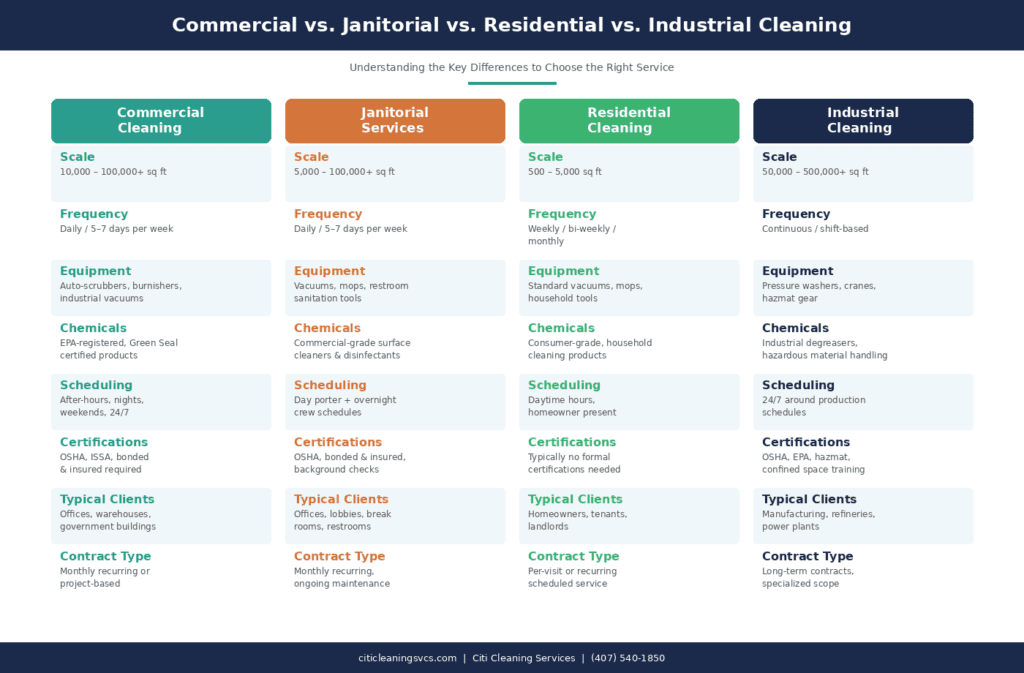
Residential cleaning focuses on private homes and apartments, typically covering 500 to 5,000 square feet using consumer-grade products and standard household tools. A residential cleaner visits weekly or bi-weekly during daytime hours when the homeowner is available.
Commercial cleaning operates at an entirely different scale. Commercial facilities range from 10,000 to over 100,000 square feet and require daily cleaning, often performed after business hours or on overnight shifts to avoid disrupting operations. The equipment is industrial-grade: auto-scrubbers that can cover 20,000 square feet per hour, commercial burnishers for hard floor maintenance, and EPA-registered disinfectants formulated for high-traffic environments.
The compliance requirements are also fundamentally different. A residential cleaner typically needs no formal certifications. A commercial cleaning company servicing office buildings, warehouses, or government facilities needs general liability insurance, workers’ compensation, bonding, OSHA training, and often background checks for all staff members.
Industrial cleaning goes beyond commercial cleaning into highly specialized environments, manufacturing plants, chemical refineries, power generation facilities, and pharmaceutical production floors. Industrial cleaning crews handle hazardous materials, confined space work, and biohazard remediation that require specific EPA and OSHA certifications beyond standard commercial cleaning credentials.
While commercial cleaning and industrial cleaning share some overlap (both use professional-grade equipment and follow safety protocols), industrial cleaning involves significantly higher-risk environments and specialized training that most commercial cleaning companies do not carry.
The terms “commercial cleaning” and “janitorial services” are often used interchangeably, but there is a meaningful distinction. Janitorial services typically refer to the ongoing, daily maintenance cleaning of a facility, trash removal, restroom cleaning, vacuuming, dusting, and surface sanitizing. This is the recurring, routine work that keeps a building operational day to day.
Commercial cleaning, as a broader term, encompasses janitorial services plus specialized project-based work: floor stripping and waxing, deep cleaning, pressure washing, window cleaning, and post-event cleanup. Think of janitorial services as the daily maintenance layer and commercial cleaning as the full spectrum of professional facility cleaning.
Part of understanding the full commercial cleaning meaning is recognizing that it is not a single service; it is a category that includes multiple specialized cleaning disciplines. Understanding these service types helps facility managers and property owners build a comprehensive cleaning program that covers every aspect of their building’s maintenance needs.
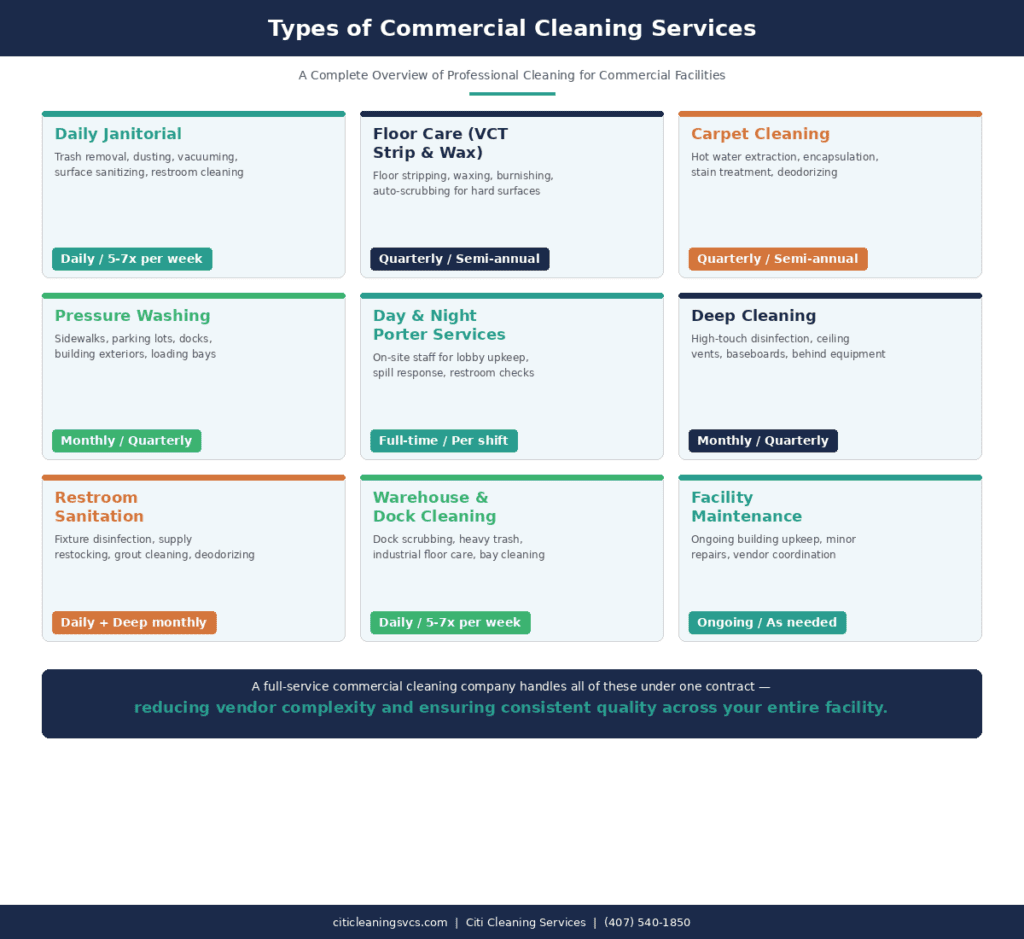
The foundation of any commercial cleaning program. Daily janitorial covers trash removal, restroom cleaning and restocking, surface dusting, vacuuming, mopping, break room sanitation, and high-touch surface disinfection. For most commercial facilities, this means a cleaning crew on-site five to seven days per week, either during business hours or on an overnight schedule.
Commercial floor care is a specialized discipline that goes far beyond mopping. The most common commercial floor service is VCT (Vinyl Composition Tile) stripping and waxing, a multi-step process that involves chemically stripping the old wax finish, deep-cleaning the bare tile, and applying multiple coats of commercial-grade floor finish to restore shine, protect the tile surface, and extend floor life.
VCT floors are found in warehouses, distribution centers, retail spaces, government buildings, and office lobbies throughout Florida. Proper strip-and-wax maintenance on a quarterly or semi-annual schedule prevents costly floor replacement and maintains a professional appearance.
Commercial carpet cleaning removes embedded dirt, allergens, stains, and odors that daily vacuuming cannot reach. The two most common methods used in commercial environments are hot water extraction (often called steam cleaning) and encapsulation, a low-moisture process that uses crystallizing chemicals to trap soil particles for later vacuuming, allowing carpeted areas to return to service faster.
High-traffic office lobbies, corridors, and conference rooms typically need professional carpet cleaning on a quarterly or semi-annual schedule. Facilities with heavy foot traffic or strict indoor air quality requirements may need it more frequently. Professional carpet cleaning extends the life of commercial carpet by removing abrasive grit that wears down fibers over time.
Commercial pressure washing addresses the exterior surfaces of commercial properties, sidewalks, parking lots, loading docks, building facades, and truck bays. Regular pressure washing prevents slip-and-fall hazards from oil buildup, removes environmental staining, and maintains the professional curb appeal that tenants and visitors expect.
Day porters are dedicated, full-time cleaning staff stationed on-site during business hours. They handle real-time maintenance, lobby upkeep, restroom checks throughout the day, spill response, conference room turnover, and visitor area maintenance. Night porters perform the full deep cleaning cycle after the building closes: thorough floor care, detailed restroom sanitation, and comprehensive surface cleaning.
Large commercial buildings often require both. A multi-tenant office building in downtown Orlando, for example, might have two day porters covering common areas during business hours and a three-person night crew performing the full cleaning scope after 6 PM.
Deep cleaning goes beyond daily janitorial to address areas that accumulate grime over time, such as ceiling vents, light fixtures, baseboards, behind heavy equipment, inside elevator tracks, and stairwell handrails. Most facilities schedule deep cleaning on a monthly or quarterly rotation to complement daily maintenance.
Commercial restrooms see hundreds of uses per day in high-traffic facilities. A professional restroom sanitation program includes fixture disinfection, grout and tile cleaning, supply restocking, deodorizing, and preventive maintenance to avoid plumbing issues. ISSA standards recommend restroom cleaning frequencies based on daily traffic volume, not arbitrary schedules.
Warehouse cleaning is a physically demanding specialization that most janitorial companies cannot handle. It includes dock scrubbing, heavy trash removal from shipping areas, industrial floor care, bay cleaning, and exterior pressure washing around loading zones. Crews working in warehouse environments need OSHA safety training and experience operating around forklifts, conveyor systems, and active shipping operations.
Facility maintenance extends beyond cleaning into the operational upkeep of a building, minor repairs, vendor coordination, light maintenance, and ongoing building care that keeps a facility running efficiently. A full-service commercial cleaning partner that also handles facility maintenance eliminates the need for multiple vendors.
Looking for a commercial cleaning partner that handles all of these services under one contract? Citi Cleaning Services provides daily janitorial, floor care, pressure washing, day and night porter services, and facility maintenance for commercial buildings across Central Florida. Get a free assessment or call (407) 540-1850.
Commercial cleaning is not limited to offices. Virtually every industry that operates out of a physical facility requires professional cleaning to maintain health, safety, and compliance standards.
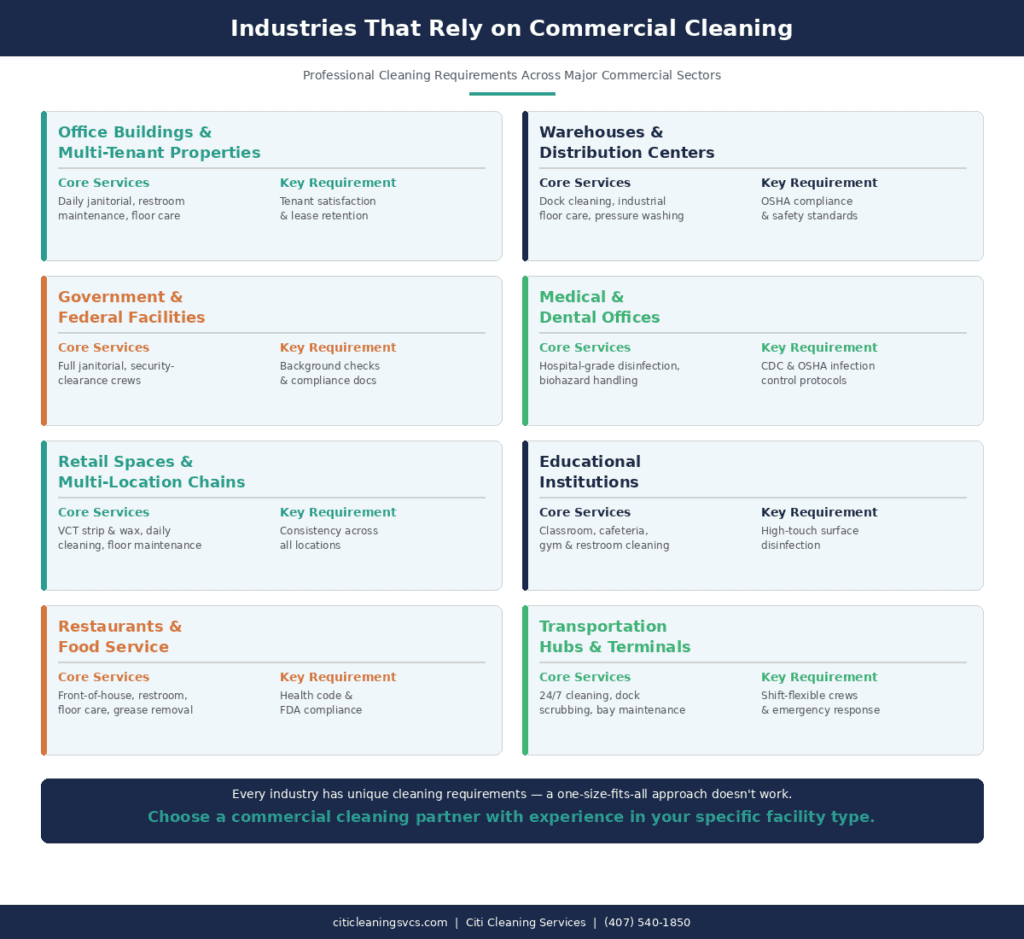
Class A and Class B commercial office space requires daily janitorial, restroom maintenance, common area upkeep, and periodic floor care. Property managers responsible for tenant satisfaction depend on consistent, reliable cleaning to prevent complaints and protect lease renewals.
The Central Florida I-4 corridor, from Orlando through Auburndale and Lakeland, is one of the fastest-growing logistics corridors in the Southeast. Warehouses and distribution centers operated by companies like FedEx, SAIA, and XPO require daily cleaning of docks, break rooms, restrooms, and industrial floors, plus periodic pressure washing of loading bays and exterior hardscapes.
Government buildings require the highest levels of security clearance, background verification, and compliance documentation from their cleaning vendors.
Citi Cleaning Services maintains active contracts with federal agencies, including U.S. Border Patrol, a level of trust that requires fully background-checked staff, bonding, and comprehensive insurance coverage.
National retail brands rely on maintenance management companies to coordinate floor care, including VCT strip and wax, across dozens of Florida locations. Consistency across locations is critical; the same floor finish quality at a store in Jacksonville must match the quality at a store in Orlando.
Truck terminals, shipping facilities, and transportation hubs operate around the clock and require cleaning crews who can work around 24/7 shift schedules without disrupting throughput.
Medical and dental facilities operate under strict sanitation requirements that go beyond standard commercial cleaning. Waiting rooms, exam rooms, and procedure areas require hospital-grade disinfection protocols, proper biohazard waste handling, and cleaning products that meet CDC and OSHA infection control guidelines.
These facilities also demand heightened attention to cross-contamination prevention, separate cleaning tools for clinical versus administrative areas, color-coded microfiber systems, and documented cleaning logs for regulatory compliance.
Schools, universities, and training facilities present unique cleaning challenges driven by high occupancy, constant foot traffic, and the need to maintain healthy environments for students and staff. Classrooms, cafeterias, gymnasiums, and restrooms all require daily cleaning with particular emphasis on high-touch surfaces, desks, door handles, shared equipment, and bathroom fixtures.
During cold and flu season, many educational facilities increase cleaning frequency and add electrostatic disinfection to reduce absenteeism.
Food service establishments require cleaning that meets local health department codes and FDA food safety standards. Kitchen exhaust hoods, grease traps, food prep surfaces, dining areas, and restrooms each have specific cleaning protocols and inspection requirements.
Many restaurant groups and food service operators contract commercial cleaning companies to handle front-of-house cleaning, restroom maintenance, and floor care while kitchen staff manage food-contact surfaces in compliance with their HACCP plans.
If you are evaluating commercial cleaning companies for the first time, or considering switching from your current provider, understanding the typical hiring process helps you ask the right questions and avoid common pitfalls.
Any reputable commercial cleaning company will begin with an on-site walkthrough of your facility. During this assessment, the cleaning company evaluates square footage, floor types, restroom count, high-traffic zones, special cleaning requirements, and any security or access protocols. This walkthrough is the foundation for an accurate scope of work and pricing proposal.
“I listen first,” says Mary Kaizer. “Let the client tell me what the burden is on their end before I propose anything. Every building is different. A 30,000-square-foot warehouse with three loading docks has completely different needs than a 30,000-square-foot multi-tenant office building with a marble lobby. The walkthrough is where we learn what actually matters to that specific client.”
Commercial cleaning companies typically price services using one of three models:
Many commercial cleaning companies require long-term contracts with 30, 60, or 90-day termination clauses. This protects the cleaning company but locks the facility owner into a relationship even if quality declines.
Contract-free cleaning services, where the cleaning company earns the business every month, are increasingly preferred by facility managers who want the freedom to hold their vendor accountable without penalty. If a cleaning company is confident in its quality, it should not need a contract to keep a client.

Before hiring any commercial cleaning company, verify the following:
Janitorial services refer specifically to the ongoing daily maintenance of a facility, trash removal, restroom cleaning, vacuuming, and surface sanitizing. Commercial cleaning is the broader category that includes janitorial services plus specialized work like floor stripping and waxing, pressure washing, deep cleaning, and facility maintenance. Most commercial cleaning companies offer both under a single contract.
A commercial cleaner performs professional cleaning services for business and institutional facilities. Daily tasks typically include trash removal, restroom cleaning and restocking, surface dusting and sanitizing, floor mopping and vacuuming, break room and kitchen cleaning, and high-touch surface disinfection. Specialized commercial cleaners also perform floor care (VCT strip and wax), pressure washing, and deep cleaning on a scheduled rotation.
Most commercial buildings require cleaning five to seven days per week. High-traffic facilities like warehouses, transportation terminals, and multi-tenant office buildings often require daily cleaning. The frequency of specialized services varies: floor stripping and waxing is typically quarterly or semi-annual, pressure washing is monthly or quarterly, and deep cleaning is monthly.
Professional commercial cleaning companies use EPA-registered disinfectants, hospital-grade sanitizers, and commercial-grade floor care chemicals that meet OSHA safety standards. Many companies, including those certified by Green Seal, use environmentally responsible products that are effective against pathogens while minimizing environmental impact. The specific chemicals used depend on the surface type, the cleaning task, and any industry-specific regulations (for example, food-grade facilities require NSF-approved products).
Commercial cleaning costs in Florida typically range from $0.07 to $0.22 per square foot per month for ongoing janitorial services, depending on facility size, cleaning frequency, and scope of work. A 20,000-square-foot office building in Orlando might pay $2,600 to $4,000 per month for five-day-per-week service from a fully insured provider. For a complete pricing breakdown, read our commercial cleaning cost guide.
The five most important factors when evaluating a commercial cleaning company are: proof of insurance and workers’ compensation, background-checked staff, management oversight (not just sending a crew), references from facilities similar to yours, and contract flexibility. A company that requires a long-term contract before you have seen their work is a red flag.
The deeper commercial cleaning meaning, beyond the definition, is that it represents an investment in people, not just a line item. Business owners who treat cleaning as a line item to minimize are making a costly mistake. Research consistently shows that clean work environments reduce employee sick days by 46%, improve productivity, and directly impact tenant satisfaction and retention in commercial properties.
When a workplace is not clean, it affects the people in it directly, leading to a lack of motivation, health issues, and decreased productivity. A professional commercial cleaning program is not a facility expense. It is an investment in your staff, your tenants, and the long-term value of your property.
For over 20 years, Citi Cleaning Services has provided fully insured, background-checked commercial cleaning for facilities across Central Florida, from multi-tenant office buildings in downtown Orlando to federal government facilities and distribution centers along the I-4 corridor. We bring management oversight to every facility, contract-free flexibility, and the kind of consistent quality that has earned us an average client retention of over 10 years.
Ready to see what a professional commercial cleaning company can do for your facility?
Call (407) 540-1850 for a free walkthrough assessment, or request a quote online. No contracts, no pressure — just a conversation about what your building needs.
