
A 24-year operator’s field guide to keeping commercial VCT floors looking professional, year after year.
By Mary Kaizer, COO, Citi Cleaning Services
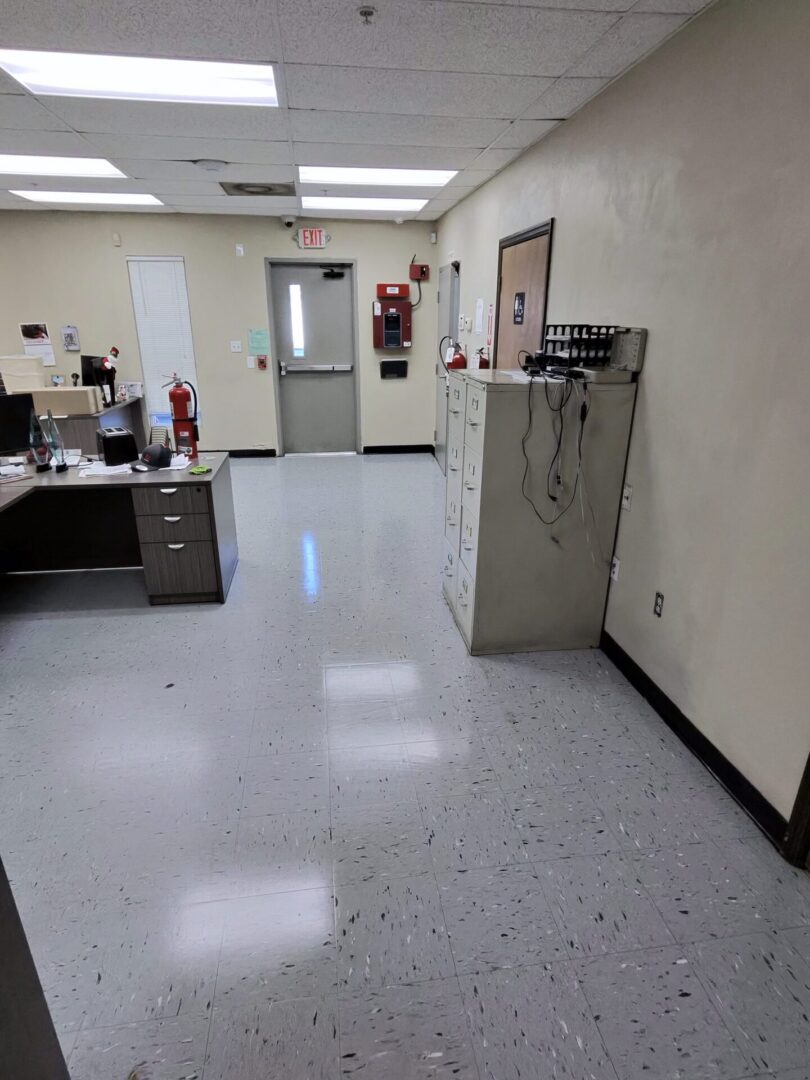
If you manage a commercial property in Central Florida, odds are good that you’re walking on vinyl composition tile right now. VCT is the workhorse flooring of American commercial real estate. You’ll find it in retail stores, hospital corridors, school cafeterias, warehouse offices, distribution center break rooms, government building lobbies, and the back-of-house in nearly every restaurant.
Done right, a VCT floor lasts 20 years or more. Done wrong, it looks worn out in three. The difference is the maintenance program, and that’s what this guide covers.
Need professional VCT floor care for your facility?
Get a free floor assessment from a 24-year Central Florida commercial floor crew. Call (407) 540-1850 or contact us through the website.
VCT is made from colored polyvinyl chloride (PVC) chips, mineral fillers, and pigments, all compressed under heat into a solid sheet about 1/8 inch thick. The standard tile size is 12 by 12 inches; 12 by 24 became more common over the last decade. The tiles get glued to a leveled subfloor, then sealed with multiple coats of floor finish (commonly called wax, though modern finishes are acrylic polymer).
Why is it so popular? Three reasons: it’s cheap to buy, durable under heavy foot traffic, and if a tile gets damaged you swap that one out instead of redoing the whole floor. That’s why it’s been the default commercial flooring in the US since the 1940s.
The catch is that VCT isn’t self-maintaining. The PVC tile itself is fine, but the protective finish coating that sits on top of it wears down constantly under foot traffic, chemicals, moisture, and grit. The wax is the only thing between your tiles and the rest of the world. When the wax fails, the tile starts to fail.
Quick clarification: VCT is not the same thing as LVT (luxury vinyl tile). LVT has a factory-applied urethane top coat, so it doesn’t need wax. VCT does. If you’re unsure which you have, look at a cracked or scratched tile. VCT has the color and pattern all the way through the body of the tile (chips and scratches barely change the look). LVT has a printed image layer under a clear top coat. The care requirements are different.
VCT care is built in four layers. Each layer is essential. Skip one and the others have to work harder to compensate, which speeds up wear.

| Frequency | What to do |
|---|---|
| Daily | Dust mop or vacuum the full floor. Spot-clean spills, especially acidic or oily. Damp-mop high-traffic zones with a neutral pH cleaner. |
| Weekly | Wet-mop the entire floor with neutral cleaner. Spray-buff scuff marks in high-traffic areas with a low-speed machine and a red pad. |
| Monthly | Deep scrub with an auto-scrubber and red or blue pad. Burnish with a high-speed machine (1,500 to 2,000 RPM) to restore gloss. |
| Annually (or as needed) |
Full strip and wax. Chemically remove every coat of old finish, then apply 3 to 5 fresh coats. Final burnish for high gloss. |
Daily. Dust mop or vacuum the entire floor to remove grit and abrasive debris. Even tiny particles act like sandpaper under foot traffic, scratching the wax. Spot-clean any spills, especially anything acidic (citrus, soda, vinegar) or oily. Damp-mop high-traffic zones using a neutral pH cleaner diluted per the label. Skip the all-purpose cleaners from the supply closet; most of them are too alkaline and dull the finish over time.
Weekly. Wet-mop the entire floor with neutral cleaner, not just the high-traffic areas. Spray-buff visible scuff marks with a low-speed floor machine and the right pad. A red pad is for buffing and recoating; black or brown pads are for stripping and will damage your finish if used on routine cleaning.
Monthly. Deep scrub the floor with an auto-scrubber, neutral cleaner, and a red or blue pad. This pulls embedded soil out of the finish surface that daily and weekly cleaning can’t reach. Follow that with burnishing, where a high-speed floor machine (1,500 to 2,000 RPM) restores gloss to the finish without removing it. Burnishing also slightly heat-cures the wax, hardening the surface for the next month.
Annually, or as the floor demands. Full strip and wax. Every coat of finish gets chemically removed back to bare tile, then 3 to 5 fresh coats of floor finish go down. This is the heaviest piece of VCT maintenance and the one that benefits most from professional execution. The full process is below.
Florida-specific note. Humidity, daily rain, sandy soil, and the kind of foot traffic you see in tourist-adjacent retail will pull this schedule tighter than a generic guide suggests. We service facilities in the I-4 corridor, central Orlando, Lakeland, and the warehouse zones around Sanford and Auburndale. Our recommended cycles tend to run 20 to 30 percent more frequent than what you’ll find in a national maintenance manual. For the full facility-by-facility frequency breakdown, our detailed strip-and-wax frequency guide covers retail, warehouses, offices, and multi-location accounts in depth.
This is the work most facilities outsource, and for good reason. A full strip and refinish takes 8 to 12 hours per 1,000 square feet, uses caustic chemicals, and requires equipment most in-house teams don’t own. Doing it wrong costs more than not doing it at all. We’ve replaced thousands of square feet of VCT for facility managers whose previous “strip and wax” provider skipped steps.

Here’s what the process looks like when it’s done correctly.
Move all furniture, equipment, and floor mats out of the space. Cover anything that can’t move (baseboards, lower wall sections, electrical outlets at floor level) with protective film. Sweep and dust-mop the entire surface. Any grit left on the floor turns into a polishing compound that grinds dirt into the tile when the stripping pad hits it.
A commercial-grade stripper gets mixed per the label (usually 1 part stripper to 4 to 6 parts water) and applied with a mop, leaving the floor visibly wet. The stripper needs dwell time, typically 10 to 15 minutes, to break the bonds between the old finish and the tile. Don’t let it dry. If it starts drying around the edges, mist with more solution.
A low-speed floor machine (about 175 RPM) fitted with a black or brown stripping pad scrubs the floor in overlapping passes. This is mechanical work. The chemistry softens the finish; the pad removes it. Edges and corners that the machine can’t reach get hand-scrubbed with a doodlebug.
All the broken-down finish, dissolved soil, and used stripper get vacuumed up. A wet-dry vacuum or auto-scrubber in extract mode handles this. Don’t squeegee the solution into a corner and leave it there; it re-deposits when it dries and contaminates the new finish.
This step gets skipped more than any other, and skipping it ruins the new finish. Rinse the entire floor with clean water (at least one full rinse, ideally two). Any stripper residue left on the tile reacts with the first coat of new finish, causing peeling, white haze, or finish that just won’t cure properly. Test by mopping with clean water and looking for foam. If the rinse water foams, you have residue and need another rinse.
Once the floor is fully dry (touch-test in multiple spots), apply the first coat of finish using a flat applicator mop. Thin, even coats. The first coat is the sealer; it bonds to the tile and gives the subsequent coats something to grip. Drying time depends on humidity and finish type, typically 20 to 45 minutes.
This is where shortcuts kill the finish. Each coat must fully dry before the next goes on. Five thin coats outperform two thick coats every time, because the polymer chains in floor finish need time to cross-link as they cure. Skip a coat and you cut the wear life of the finish in half. We typically apply five coats on warehouses and retail; three coats is the minimum for any commercial application.
Once the last coat has cured (most finishes need 24 to 48 hours for full cure before burnishing), a high-speed burnisher with the appropriate pad restores high gloss and hardens the surface. The result is the wet-look shine that makes a VCT floor look like new.
That’s the process. Eight steps, roughly 8 to 12 hours of labor per 1,000 square feet for a competent two-person crew. If your current provider claims to do a strip-and-wax in three hours per thousand feet, they’re skipping rinses, coats, or both.
Citi Cleaning specializes in VCT floor care across Central Florida.
Call (407) 540-1850 for a free quote, or visit our commercial floor waxing service page for more on our process.
Most facility managers wait too long. By the time the floor looks bad enough to obviously need a strip-and-wax, the finish has been compromised for months and damage to the tile underneath may already be permanent.
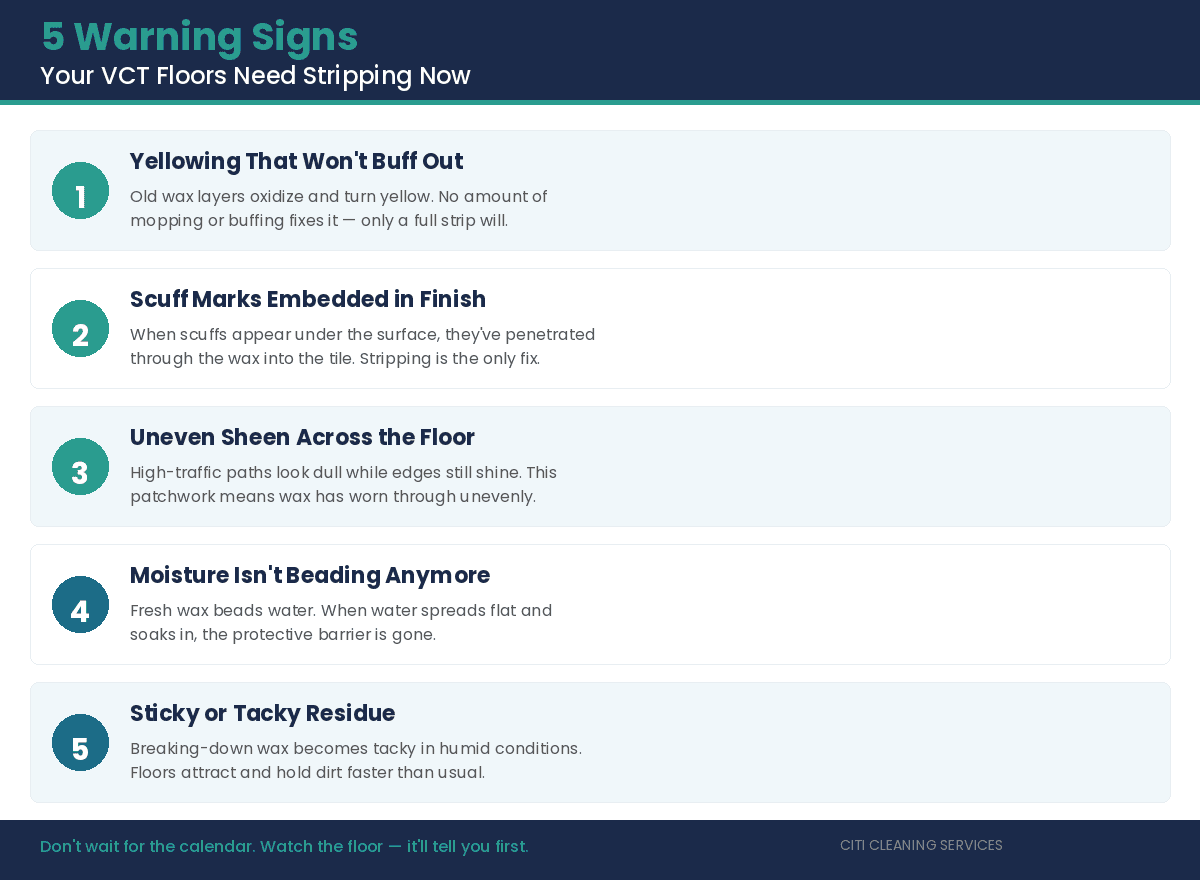
Five signs to watch for:
Yellowing in the finish. A clear floor finish that’s gone yellow or amber is breaking down chemically. The acrylic polymer is oxidizing, and no amount of cleaning will restore it. Yellowing means strip and refinish.
Visible traffic lanes. When you can see the path people take through the building because the finish is duller in those areas, the wax has worn thin in the high-traffic zones. This is a strip-and-wax cue, or at minimum a scrub-and-recoat cue if you catch it early.
Scuff marks that won’t buff out. A scuff in the finish should disappear after spray-buffing with a red pad. If your team is buffing and the marks stay, the damage is in the tile itself or the finish is too thin to recover. Time to strip.
Dull appearance despite cleaning. If you’ve mopped and the floor still looks tired, the finish has either picked up too much embedded soil or has worn to the point where light no longer reflects evenly off it.
Peeling, flaking, or chipping finish. This is the failure stage. The bond between coats has broken, or the bond between the bottom coat and the tile has broken. Strip immediately, because every day you leave it, more contaminants work down into the gap and start staining the tile.
The faster you catch any of these signs, the cheaper the fix. A scrub-and-recoat at the first hint of dulling costs roughly a third of a full strip-and-wax, and prevents the wear cycle from progressing. Waiting until the floor looks bad means you’re paying for both the strip and the early replacement of damaged tiles.
After 24 years of stripping and refinishing VCT across Florida, we see the same handful of mistakes drain budgets year after year. Most of them come from in-house teams or under-trained subcontractors trying to save money on chemicals or labor.
Using the wrong chemicals. Ammonia, pine cleaners, vinegar, and bleach all damage commercial floor finish. They strip the polymer over time, leaving the tile exposed. We’ve inherited accounts where the previous janitorial team used a household pine cleaner for two years, and we had to strip and refinish the entire facility at the customer’s expense before we could even start normal maintenance. Use a neutral pH cleaner. Always.
Skipping coats during refinish. Two coats of finish is not “strip and wax.” Two coats wears out in three months. Five coats wears out in 12. The cost difference between two coats and five coats is the cost of the finish itself, maybe $20 to $40 per 1,000 square feet. That’s nothing compared to having to redo the work twice as often.
Not allowing dry time between coats. Floor finish needs to fully cure between coats. Rushing causes the coats to blend rather than stack, which sounds fine but produces a single soft layer instead of multiple hard layers. Polymers cross-link as they cure; interrupting that process destroys the wear resistance you’re paying for.
Using dirty mop water. A mop bucket of dirty water is a tool for redistributing dirt. Change the water when it’s visibly soiled. We tell our crews: if you wouldn’t wash your face in it, don’t wash a floor with it.
Over-buffing without recoating. A red buffing pad removes a thin layer of finish every time it runs. That’s fine when the floor has 5 coats of finish to spare. When the floor has 2 coats left because nobody’s recoated in 18 months, every buffing pass is thinning the protective layer until eventually you’re buffing on bare tile. The result is dull tile that no amount of buffing will brighten, because there’s nothing left to polish.
“The level of cleaning is no different than another profession, like being a nurse,” says Mary Kaizer, COO of Citi Cleaning Services. “It requires expertise, standards, and pride, just like any respected field.”
The honest answer is that you should do both. Daily cleaning is in-house work. Annual strip-and-wax is professional work. Most facilities mess this up by trying to take both pieces in-house, then watching their floors deteriorate.
What in-house teams can handle well: dust mopping, vacuuming, spot cleaning, damp mopping with neutral cleaner, weekly wet mopping. Anyone can be trained for daily floor care in an afternoon. The equipment is cheap (a $30 dust mop and a $200 mop bucket gets you started).
What in-house teams almost always do poorly: monthly auto-scrubbing, burnishing, and the full strip-and-wax cycle. These need:
The math usually favors outsourcing the periodic and restorative work even at facilities with strong in-house janitorial. A $1,000 strip-and-wax by a professional crew is cheaper than a $3,000 in-house disaster that requires a $2,000 redo. For more on commercial cleaning pricing across facility types, our 2026 commercial cleaning cost guide covers the full picture.
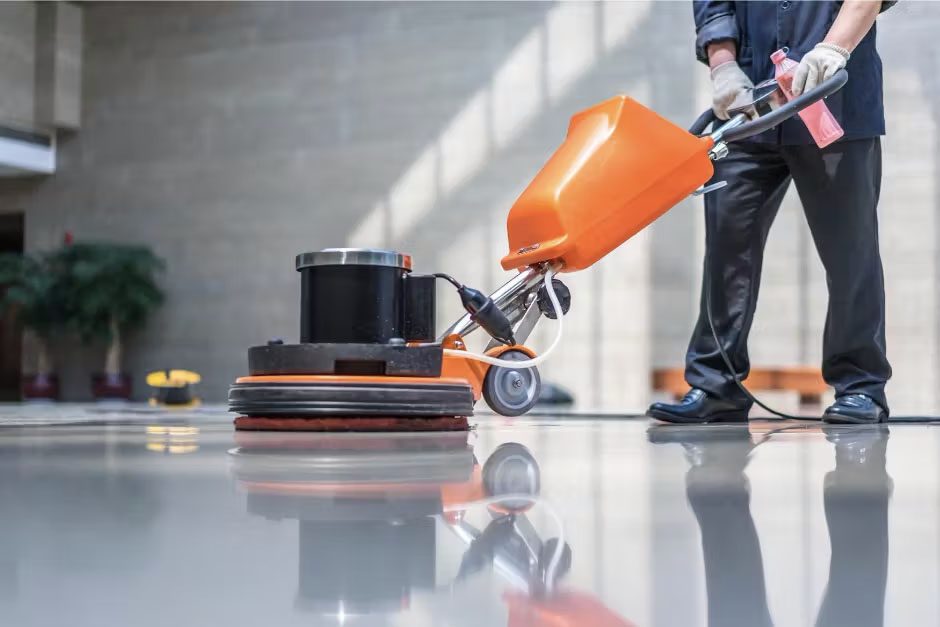
VCT floor care is what we’re known for in Central Florida. We’ve been at it since 2002. Twenty-four years of stripping, waxing, burnishing, and maintaining VCT across hundreds of commercial accounts in Orlando, Tampa, Jacksonville, Lakeland, Auburndale, Melbourne, and across the I-4 corridor.
The accounts we service include national logistics and retail brands like FedEx, SAIA, and XPO, multi-location retail chains, hospital systems, school districts, government buildings, and Class A office property managers. The throughline is that our work has to hold up under the most demanding commercial traffic in Florida.
What we bring to a VCT account:
If your facility has VCT floors in Central Florida and you want them on a real schedule (or you want a second opinion on whether your current provider is doing the work properly), we’re the right call. See our commercial floor care services or our broader janitorial services for Orlando for the full scope of what we cover.
For most commercial facilities in Central Florida, every 6 to 12 months. High-traffic retail and big-box stores often need quarterly. Lower-traffic offices can sometimes stretch to 18 months with strong daily care. The right cadence depends on traffic, climate, and how well the floor is maintained between strips. Our detailed frequency guide by facility type breaks this down further.
About 8 to 12 hours of labor per 1,000 square feet for a competent two-person crew, plus 24 to 48 hours of cure time before the floor is back in full service. Most commercial accounts schedule the work overnight or across a weekend so business hours aren’t affected.
Yes, almost always. If the tile itself is intact (not cracked, gouged, or peeling from the subfloor), strip-and-wax fully restores appearance. A 20-year-old VCT floor that’s been refinished correctly looks the same as a 2-year-old VCT floor. Replacement is only required when the tile substrate is damaged, the adhesive has failed, or the floor contains asbestos. In buildings from before the early 1980s, asbestos abatement is required before any work begins.
Buffing is low-speed work (under 1,000 RPM) used to remove scuff marks and apply minor polish. Burnishing is high-speed work (1,500 to 2,000+ RPM) used to restore gloss to floor finish and heat-cure the surface. Burnishing produces the wet-look shine you see on high-end commercial floors. Buffing is more of a maintenance step between burnishings.
A neutral pH commercial floor cleaner, diluted per the manufacturer’s label. Avoid ammonia, pine cleaners, vinegar, citrus cleaners, and bleach. All of those break down the wax finish. The neutral cleaner brand matters less than two things: pH must be neutral (between 7 and 9), and your team has to dilute correctly. Concentrated cleaner left on a floor causes its own residue problems.
VCT done right looks professional for two decades. VCT done poorly looks tired in three years and needs replacement no facility manager wants to pay for. The difference is the maintenance program.
If you manage a commercial facility in Central Florida and want a free quote, a site visit, or a second opinion on your current janitorial provider’s floor program, call (407) 540-1850 or contact us through the website. We’ll send a senior technician to your site, walk the floors with you, and give you a straight answer on what your VCT actually needs (and what it doesn’t).
