
Commercial floor waxing is the process of stripping old finish from a hard floor, applying multiple thin coats of a protective liquid finish, and burnishing it to a durable shine that protects the tile underneath from foot traffic, grit, and moisture.
Facility managers rely on it because a proper wax cycle can add years to a VCT installation, cut daily cleaning time, and keep insurance-worthy slip resistance in every corridor. Our team at Citi Cleaning Services has stripped and waxed floors across Central Florida since 2004 — offices, warehouses, schools, retail, transportation hubs.
This guide walks through the exact 7-step process the pros use, how many finish coats each traffic level really needs, how to match finish to facility, and what drives the price up or down. Read on to see the recoat cadence that keeps a wax cycle looking good 12 months in.
Key Takeaways
- Commercial floor waxing = 3-step cycle: strip old finish, apply 4-5 thin coats of new finish, then maintain with weekly scrub and monthly burnish.
- Coat count matters more than product brand. Standard offices need 4 coats; retail and schools need 5; extreme-traffic warehouses need 5-6 plus burnish.
- Most floors get re-waxed every 12 months if maintained correctly between cycles. Poor maintenance cuts that in half.
- Cost is driven by square footage, traffic, access hours, and how much furniture crews must move — not the wax itself.
- Green Seal-aligned low-VOC finishes let occupied buildings reopen faster and reduce indoor air complaints.
- Skipping recoats is the fastest way to shorten VCT life. Under-waxed tile shows scuffs, absorbs stains, and starts chipping at the edges.
Commercial floor waxing is the professional application of a liquid acrylic or polymer finish over hard flooring — most often vinyl composition tile (VCT), but also concrete, terrazzo, and some rubber floors.

The finish is not decorative. It is a sacrificial protective coat. Traffic wears it down instead of wearing down the tile.
Without it, VCT tiles absorb grit, scuff marks embed permanently, moisture seeps into seams, and the entire floor needs replacement after 4-6 years instead of 20+.
The word “wax” is a holdover from the 1960s when floor finishes were literally carnauba wax. Today, almost no commercial product contains wax.
Finish is the accurate term — a water-based acrylic polymer emulsion. Polish usually refers to a lighter, spray-applied version used between full recoats. Wax is the everyday label facility managers still use for all of it, and this guide uses it that way for readability.
Knowing the difference matters when you spec a job. A contractor quoting “wax” and one quoting “20-25% solids acrylic finish, 4 coats” are describing the same thing at very different levels of professionalism.
Bottom line: modern commercial floor waxing is polymer chemistry, not wax. The label stuck but the product changed.
Your floor tells you when the finish is failing. The trick is knowing what to look for before the tile itself starts to suffer.
Walk your building at the end of a business day, when overhead lights are on and foot traffic is gone. Look at the floor at a low angle from about 20 feet away.
Traffic lanes. Dull paths where people walk most — through main entries, cafeteria lines, and corridor intersections — are the first spot finish disappears.
Yellowing or haze. Old finish loses clarity long before it wears through. A hazy amber cast under LED lighting means the top coats have oxidized.
Scuff marks that will not buff out. When black shoe marks stay after a spray-buff pass, the finish is too thin to absorb them.
Water no longer beads. Drop a teaspoon of water. If it spreads flat instead of pearling, the finish has broken down.
Grit you can feel underfoot. Fresh finish makes grit slide off during dust mopping. Worn finish traps it.
Edge chipping. Corners and seams starting to chip mean the VCT itself is now exposed. That is a re-wax emergency — schedule the strip immediately.
If you see two or more of these signs in the same area, put that zone on the calendar for a full recoat within 30 days.
A proper strip-and-wax is a 7-step sequence. Skip any step and the finish either bubbles, peels, or wears through in months instead of a year.
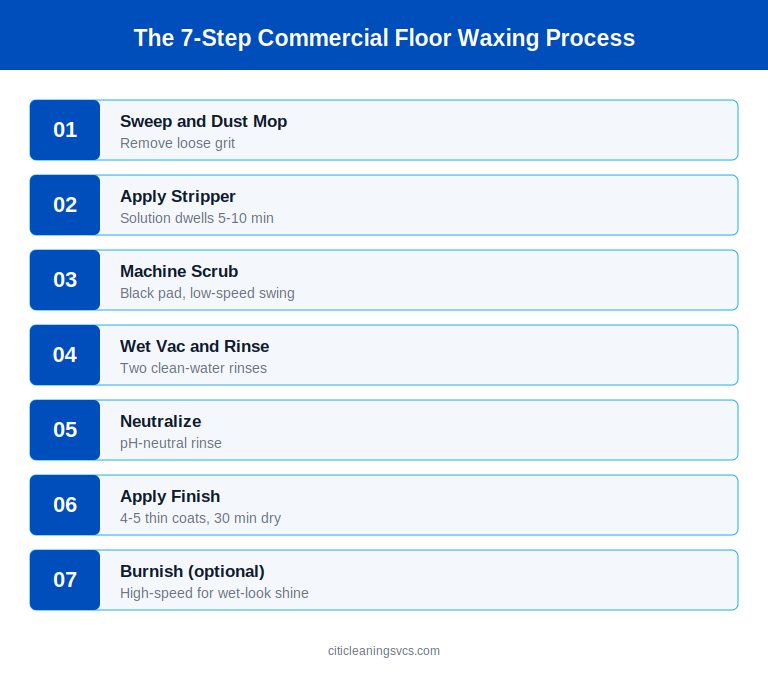
The full cycle on a 10,000 sq ft area runs 8-14 hours depending on how heavy the old finish build-up is and how much furniture the crew has to move. Most jobs happen overnight or on weekends so tenants never see the disruption.
Loose grit is abrasive. If it stays on the floor when stripper hits it, that grit will scratch the tile.
Trained crews microfiber dust mop in a serpentine pattern from the back of the room toward the exit, then vacuum baseboards and corners a shop vac can reach.
A properly diluted stripper (usually 1:4 with cool water) is mop-applied in 200 sq ft sections. Cool water — hot water flashes the stripper off before it can break down the finish.
Dwell time is 5-10 minutes. Any less and the finish will not release. Any more and the stripper starts drying and locking finish back onto the tile.
A 175 RPM low-speed swing machine with a black or brown stripping pad breaks the softened finish free. High-speed machines are the wrong tool here — they push the finish around instead of lifting it.
One pass in overlapping stripes covers the whole area. Edges and corners get hand-scraped with a doodlebug or edging pad.
Wet vac removes the dissolved finish. Then two clean-water rinses pull residue out of the tile pores. Residue left behind is the number one reason new finish bubbles or fails to bond.
Stripper is highly alkaline. New finish will not bond to alkaline tile. A pH-neutral neutralizer rinse resets the surface to about pH 7 and lets the finish grip.
This is where most jobs go wrong. Two thick coats look fine day one and fail in 90 days. Four to five thin coats build a durable film that lasts 12+ months.
Application uses a lint-free finish mop or microfiber flat mop. Each coat is applied in a figure-8 pattern parallel to the longest wall, edges first. Dry time between coats is 25-45 minutes depending on humidity — Central Florida humidity pushes that to the higher end.
High-gloss finishes get burnished with a 1500-2000 RPM high-speed burnisher and a natural fiber or aqua pad. Standard-gloss and matte finishes skip this step.
Burnishing takes 45-60 minutes per 5,000 sq ft and produces the wet-look shine associated with premium retail and hospitality floors.
Finish selection is a match between the traffic your building handles and the solids content of the product. Get this wrong and you either overpay or the finish fails early.
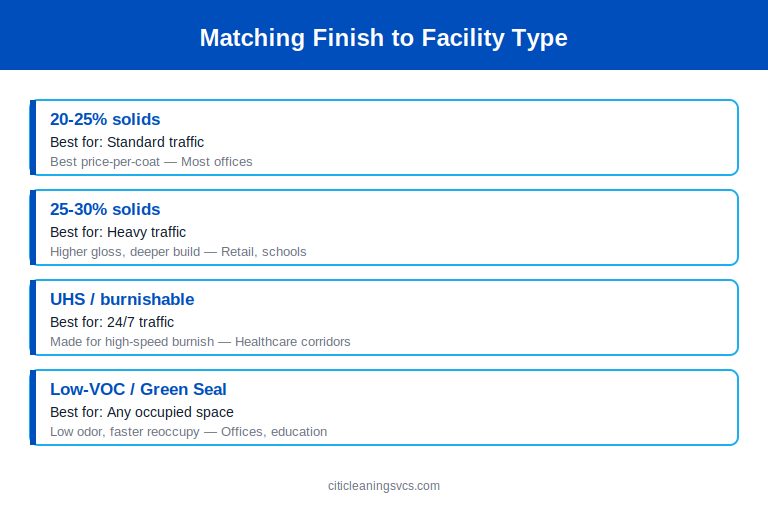
Every commercial finish is labeled by its solids percentage — the concentration of acrylic polymer in the bottle. Higher solids means more coating per coat, more durability, and more cost per gallon.
20-25% solids. The workhorse for standard office corridors and administrative spaces. Best price per coat, easy to recoat.
25-30% solids. Heavy-traffic finishes for retail, education, and multi-tenant lobbies. Higher gloss and thicker film per coat.
UHS (ultra-high-speed) burnishable. Formulated to respond to daily high-speed burnishing. Used in 24/7 healthcare corridors and hospitality where the shine has to look new every morning.
Matte and satin finishes hide scuffs better and reduce glare. Good for offices with a lot of ambient light. High-gloss finishes read as “clean” to visitors but show every mark until the next burnish.
Occupied buildings — schools, healthcare, government, LEED-certified offices — increasingly require finishes with low volatile organic compound (VOC) content. Green Seal-certified finishes reoccupy faster and reduce indoor air complaints. Our crews use Green Seal-aligned products wherever the facility spec allows.
One rule that saves money every time: pick the finish for the highest-traffic zone in the building and use it everywhere. Buying two products creates inventory chaos and no measurable savings.
Four coats is the professional minimum for any commercial VCT floor. Anything less is a job cut short.

Coat count is the single strongest predictor of how long a wax job lasts. It matters more than the brand of finish, the applicator, or the equipment used.
Light traffic (private offices, storage rooms): 3 coats acceptable, 4 preferred.
Standard traffic (corridors, conference rooms, break rooms): 4 coats is the industry standard.
Heavy traffic (retail, K-12 schools, healthcare lobbies): 5 coats minimum.
Extreme traffic (warehouses, transportation hubs, big-box retail): 5-6 coats plus daily burnish.
Two thick coats and five thin coats can measure the same wet mil thickness. But the five-coat system dries harder, cures more evenly, and resists wear 3-4x longer.
Thick coats trap solvent and moisture in the middle layer. That soft layer becomes the weakest link. When the top wears through, the whole system peels down to the tile in flakes.
Manufacturer warranties on commercial finishes almost universally require 4 coats minimum for the finish to be considered properly applied. Cutting to 2-3 coats voids most product warranties — which matters if a slip-and-fall claim ever ties back to floor condition.
National price ranges for commercial strip-and-wax run $0.30 to $0.80 per square foot. Where your job lands in that range depends on six variables that have nothing to do with the finish itself.

Understanding these variables lets you request a fair quote and spot the vendors cutting corners.
Square footage. Larger areas get better per-square-foot pricing because setup and mobilization are fixed costs. A 20,000 sq ft job usually prices 20-30% less per foot than a 3,000 sq ft job.
Traffic load and existing finish condition. Neglected floors with heavy build-up need extra stripping passes. Some jobs need two full strips before the tile is clean enough for new finish.
Access hours. Nights, weekends, and 24/7 facility work carry premium labor rates. Business-hours work is cheaper but usually not practical.
Furniture moving. Every desk, filing cabinet, and gondola the crew has to move adds labor. Sites that pre-clear the floor pay less.
Frequency of service. Facilities on a 12-month recoat contract pay less per cycle than one-off calls because the floor never gets to a critical state.
Coat count. A 5-coat job costs about 25% more than a 3-coat job — but lasts twice as long, so the annualized cost is lower.
The lowest quote is almost always the shortest-lasting job. A $0.28/sq ft two-coat job that needs redoing in six months costs more per year than a $0.55/sq ft five-coat job that lasts 14 months. Ask every vendor for coat count in writing before comparing prices.
Citi operates contract-free — no long-term commitments — so facilities can test the service on a single area before scaling to the full building.
A perfect wax job with poor daily maintenance fails in six months. A four-coat wax job with disciplined maintenance easily lasts 14-18 months.
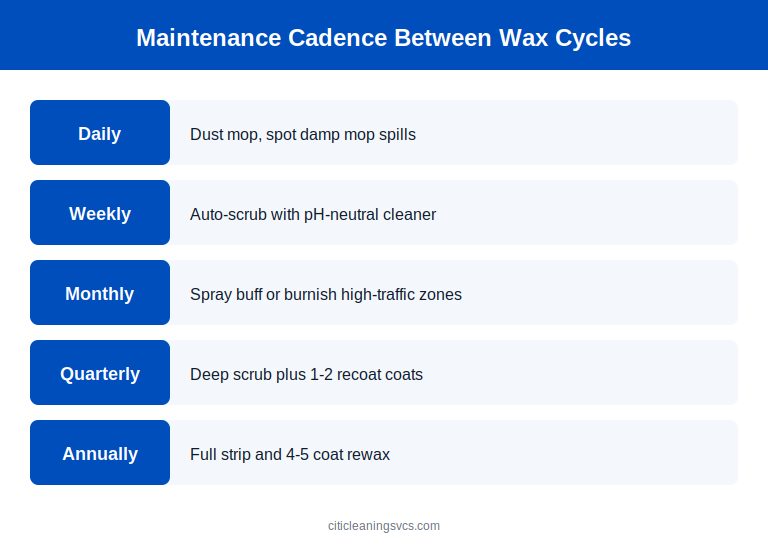
Between full recoats, your janitorial service should be running a five-tier cadence that catches wear before it eats through the finish.
Every day, the floor gets microfiber dust mopped. Spills get damp mopped with a clean, wrung-out microfiber, never a dripping string mop that leaves puddles.
A ride-on or walk-behind auto-scrubber with a red or white pad and a pH-neutral daily cleaner removes embedded soil the dust mop misses. pH-neutral is critical — alkaline daily cleaners break down the finish itself.
Corridors, entries, and cafeteria lines get a monthly spray-buff. This lays down a fresh thin restorer coat, then buffs to a shine — extending the life of the underlying finish.
Twice a year, worn areas get a light deep scrub with a blue pad, followed by 1-2 fresh finish coats. This is the difference between a floor that limps to 12 months and one that easily reaches 18.
Once a year, the full 7-step cycle runs again. If the quarterly deep scrubs kept the surface honest, the annual strip is faster and uses less product.
This cadence works in every building type we service — from warehouses in Orlando to education facilities to office buildings across Central Florida.
The math on in-house floor waxing rarely works below 50,000 square feet of hard floor. Above that, it depends on how much OSHA training and equipment amortization you want to manage.
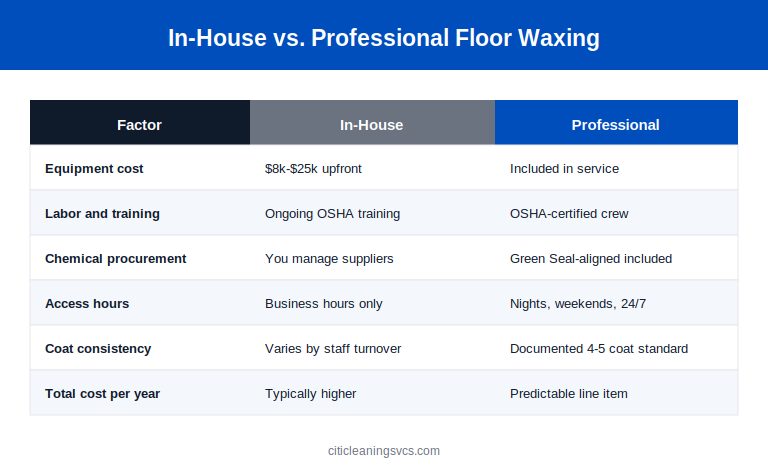
Here is the honest breakdown of what each path really costs.
Buying a low-speed swing machine, a high-speed burnisher, wet vac, auto-scrubber, and chemical storage runs $8,000-$25,000 upfront. Then you need OSHA-trained operators, PPE, MSDS binders, and someone tracking recoat schedules. Turnover means retraining every 6-12 months.
The equipment sits idle 340+ days a year in most buildings. Insurance still covers it, storage still uses square footage, and maintenance still happens.
A crew like ours brings the equipment, chemicals, OSHA-certified operators, and Green Seal-aligned finishes as a line item — no capital outlay. Central Florida facilities also get night and weekend windows so the floor is done before staff arrive.
Coat consistency is documented. Every job runs the same 4-5 coat standard whether the operator has been with us 6 months or 10 years — our average crew tenure is over 10 years.
Single-tenant warehouses over 100,000 sq ft with 24/7 operations sometimes justify in-house floor care because the equipment amortizes across daily use. Everything smaller usually pays more per year going in-house than out.
For most Central Florida facility managers, the right question is not “in-house or professional” — it is how often the professional crew should come.
Answers to the questions Central Florida facility managers ask us most about VCT waxing and finish selection.
Most commercial VCT floors need a full strip and rewax every 12 months, with quarterly deep scrub and recoat between cycles. High-traffic retail and school floors sometimes need a full rewax every 6-9 months.
Four coats is the industry minimum for a standard commercial floor. Heavy-traffic areas need 5 coats, and extreme-traffic warehouses need 5-6 coats plus daily burnishing.
A 10,000 sq ft strip-and-wax takes 8-14 hours end to end, including dry time between coats. Most jobs happen overnight or on weekends so the floor is walkable by the next business day.
Yes with low-VOC Green Seal-aligned finishes and section-by-section scheduling. Fully occupied jobs take longer because crews cordon off one area at a time.
Stripping removes the old finish down to the bare tile. Waxing — technically applying finish — puts new protective coats on top. A complete cycle always does both.
Commercial strip-and-wax typically runs $0.30 to $0.80 per square foot depending on square footage, coat count, access hours, and how much furniture the crew moves.
Yes. Citi Cleaning Services provides contract-free floor waxing across Central Florida so facilities can start with a single area and scale from there. Call (407) 540-1850 to scope a job.
A 25-30% solids commercial acrylic finish applied in 5 coats, then maintained with monthly burnishing. For 24/7 healthcare and hospitality, a UHS burnishable finish holds up best.
Commercial floor waxing is not a mystery product — it is a disciplined 7-step process, a coat count that matches your traffic, and a maintenance cadence that keeps the finish honest between cycles.
Facilities that treat it that way get 12-18 months out of every wax cycle and 20+ years out of their VCT installation. Facilities that cut coats and skip maintenance pay more, more often, and still end up replacing tile.
Step 1 — Walk your floor at end of day. Look for traffic lanes, yellowing, scuffs, and non-beading water. Note every zone showing two or more failure signs.
Step 2 — Pull your current maintenance schedule. Confirm you have daily dust mopping, weekly auto-scrub with pH-neutral cleaner, and quarterly deep scrub plus recoat on the calendar. Add whatever is missing.
Step 3 — Get written quotes with coat count. Any vendor who will not commit to 4-5 coats in writing should be removed from the shortlist. Compare annualized cost, not per-cycle cost.
Step 4 — Set your recoat calendar for the next 12 months. Book quarterly deep scrubs and the annual full strip now, based on your building’s occupancy calendar. Waxing scheduled around your operations is waxing that actually gets done.
For a deeper dive on the underlying tile, read our companion guides on VCT floor care and how often to strip and wax VCT floors. For OSHA compliance on floor machines, see OSHA equipment guarding standards. Industry certification programs are catalogued by ISSA cleaning industry standards.
Related resources across the site: the commercial floor waxing service page, the broader floor care program, and facility maintenance in Orlando. Regional coverage extends to Lakeland and Tampa. Learn about the family-owned, M/WBE team on the Citi Cleaning Services home page.
